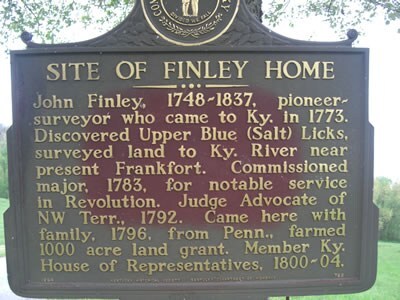
Marker #789 Site of Finley Home
Marker #789 stands near the end of Hilltop Road southeast of Flemingsburg. Hilltop Road dead ends at the Licking River. The marker is right past the address of 6543 Hilltop Road, a private property.
Text
Historical Marker #789, “Site of Finley Home,” located at the end of Hilltop Road at the Licking River in Fleming County. This marker commemorates John Finley, a veteran of the French and Indian War (1754-1763) and a Kentucky legislator. Born in Shippensburg, Pennsylvania, on July 17, 1748, before coming to Kentucky Finley traded cattle to the French near the Great Lakes.
After serving in the French and Indian War, in 1773, Finley traveled down the Ohio River with a party led by Captain William Thompson. The men ventured to the mouth of Cabin Creek, where they began surveying land. Finley and a few others then explored Licking Creek, where they surveyed and marked both the Upper Blue Lick and the Lower Blue Lick.
These surveys continued until they encountered Native Americans. Finley, who knew some native language after trading in the Great Lakes area, understood that the Native Americans did not want them there. Finley refused to leave, and when the tribes saw they were outnumbered, they retreated. Finley and Thompson, fearing more would arrive, headed back to Ohio to safer lands.
When Finley did return to Kentucky, he learned that Virginia did not recognize the surveys because they were not commissioned by Virginia. However, Finley had made land improvements to areas he had surveyed on the Upper Blue Licks, which, according to the 1779 Land Acts, made him eligible to claim most of the land.
In 1789, Finley joined Colonel James Garrard and marked land in what is now Fleming and Nicholas counties. Again, worries of Native American attacks made it nearly impossible to remain in the area. Finally, in 1796, he settled in Fleming County with his family along the Licking River and built a two-story home. The only remnants remaining today are the Finley graveyard.
In 1798, Finley was appointed as an overseer of the road he resided. A year later, the county named him as a member of the board of land arbitrators. In 1800, he was elected as a state representative, serving until 1804. At the time, he was also the local justice of the peace.
In 1809, Finley established a tavern near his home, since it was a popular place for a ferry on the Upper Blue Licks. Moreover, travelers frequently visited the area to procure salt from the licks. About six years later, Finley moved about a mile north from his home and tavern.
Finley’s property lines were heavily contested as they conflicted with claims surveyed by other people, including John Durham. For many years, Finley and Durham had been in and out of the courts over land disputes. In 1836, Finley eventually resigned his claims; he was over seventy years old and his eyesight was failing. He sold off the remaining land to his son-in-law, John Peebles.
During his last remaining years, Finley led a quiet life. Often, his neighbors visited him and read his favorite books to him (Washington and Marion by Parson Weems). Finley passed away on April 10, 1837. He was buried in the Finely cemetery near his first home, where the historical marker is posted at the end of the road.
Finley was survived by his wife, Hannah Duncan Finley, the daughter of David Duncan, another member of Thompson’s surveying party.
Files