Farmington Historic Plantation
Text
Historical Marker #2231 in Louisville denotes Farmington Historic Plantation, a fourteen-room Federal-style home built by John and Lucy Speed in 1816. The house was designed from plans drawn by Thomas Jefferson. For much of its existence, Farmington was 550-acre hemp plantation with a large slave population. Abraham Lincoln, a close friend of John Speed's son, Joshua, spent about three weeks at Farmington in 1841.
Abraham Lincoln met Joshua Speed in 1837, on the day Lincoln arrived in Springfield, Illinois. They took an instant liking to each other and the almost penniless Lincoln did not hesitate when Joshua Speed offered to share his lodgings. The two men roomed together for four years. They remained close friends and confidants throughout Lincoln's life, including the Civil War years, despite their differing political opinions. In 1864, Lincoln appointed Speed's older brother, James, as Attorney General of the United States.
Files
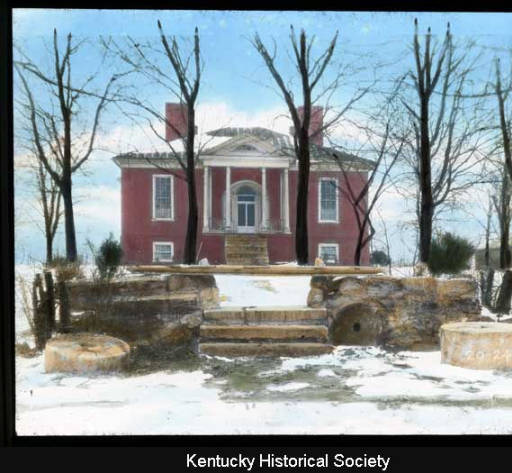
Farmington
Artist's rendition of Farmington. ca. 1934. Image Courtesy of the Kentucky Historical Society
Kentucky Lincoln Heritage Trail Logo
The Kentucky Lincoln Heritage Trail is a scenic route through central Kentucky featuring museums and historic sites with ties to the sixteenth president. The logo was created by the Kentucky Historical Society during the Abraham Lincoln Bicentennial observance. Image Courtesy of the Kentucky Historical Society
Farmington
The Speed home at Farmington was built between 1815 and 1816 by John and Lucy Speed. When John Speed died, his son Joshua took over operation of the plantation. Photograph courtesy of Tim Talbott.
Enslaved Memorial at Farmington
Farmington plantation primarily grew hemp and produced goods related to that crop, such as rope and bagging . The Speeds owned a number of enslaved people to do the plantation's labor intensive work. Today, a memorial commemorates those enslaved individuals. Photograph courtesy of Whitney Todd.
Farmington Stone Barn
Farmington's agricultural output included a ropewalk and weaving house where hemp fiber was processed into usable products. Structures, like the barn pictured here, were instrumental in plantation manufacture. Photograph courtesy of Whitney Todd.