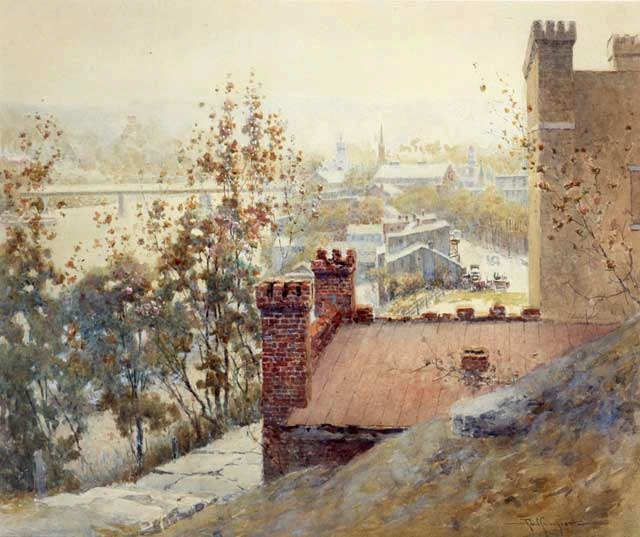
State Arsenal
Text
Historical Marker #1490 in Frankfort notes the location of the State Arsenal building, which now serves as the Kentucky Military History Museum.
In 1836, a devastating fire and explosion that heavily damaged the state arsenal necessitated the construction of a new building to store Kentucky's military weapons. Delayed for several years, in 1850 the state legislature appropriated $8,000 for the construction of a new arsenal. Because of the past fire, it was stipulated that the building be built a half a mile from the state capital. That specific provision, however, was later removed, and a suitable site on the east side of town was selected. Mexican War veteran and Frankfort native Nathaniel C. Cooke was selected as the architect and he chose a Gothic Revival design.
The building's location soon became known as Arsenal Hill. Located above a railroad tunnel built through that hill and adjacent to the Kentucky River, the building was situated on a major thoroughfare leading into downtown Frankfort. The arsenal was poised to distribute arms at a moment's notice. In the wake of John Brown's 1859 raid on the federal arsenal at Harpers Ferry, Virginia, Kentuckians felt their arsenal was secure. One newspaper editor posited that the arsenal was "in excellent condition, and is not likely to surrender to a dozen . . . Browns." He further warned, "Any Harper's Ferry scoundrel that turns up here will be hung in front of the arsenal, over the [bluffs of the Kentucky] river.'
After Kentucky officially sided with the Union in September 1861, the arsenal functioned as a cartridge making factory. Women and girls combined black powder, lead bullets, and paper to construct cartridges for the Union army. A year later, when Frankfort was captured by Confederate forces led by General Braxton Bragg, the arsenal and its contents fell into rebel hands. Among the items captured were guns, powder, lead, and manufactured cartridges. The arsenal was recaptured by the Union army a month later. The building was also used in 1864 to help repel a Confederate raid on Frankfort. Among the defenders was the building's architect, Nathaniel C. Cooke.
Weapons stored in the arsenal armed and supplied Kentucky volunteers in the Spanish American War and the men who served in actions against Poncho Villa on the Texas-Mexico border.
In 1933, the building was damaged by fire. Prisoners from the neighboring Kentucky State Penitentiary helped extinguish the blaze. The damage was soon repaired and the building was used by the Kentucky Department of Military Affairs.
The arsenal was coverted to the Kentucky Military History Museum in 1974. The Kentucky Historical Society continues to operate the musuem in partnership with the Kentucky Department of Military Affairs.
Files

1860 View of Frankfort
This view of Frankfort from Blanton's Hill, also known as Fort Hill, shows the Kentucky State Penitentiary in foreground and the castle-looking State Arsenal in the center background. Courtesy of the Kentucky Historical Society.
1871 Frankfort Birds-Eye View Map
The State Arsenal is visible on the left in this birds-eye vew map of Frankfort in 1871. This view is from the north, looking south. Courtesy of the Kentucky Historical Society.
State Arsenal
This photograph, taken on the bank of the Kentucky River, shows the State Arsenal on the bluff above. Courtesy of the Kentucky Historical Society.
State Arsenal
This painting of the State Arsenal shows the building on the bluff looking over Kentucky River. Courtesy of the Kentucky Historical Society.
Scott Brown Letter
This December 1860 letter from Kentucky Adjutant General Scott Brown to militia captain Edward Hobson reguests Hobson to return weapons to the State Arsenal. Courtesy of the Kentucky Historical Society.
Nathaniel C. Cook
This portrait shows the architect of the State Arsenal Nathaniel C. Cook. Cook was a Mexican-American War veteran and served in defense of the arsenal during the Civil War. Courtesy of the Kentucky Historical Society.
Dinner Plate
The State Arsenal is depicted on this commemorative dinner plate. Courtesy of the Kentucky Historical Society.