Great River Tragedy
Text
Historical Marker #720 in Gallatin County notes the tragic steamboat collision between the "America" and the "United States" on the Ohio River in 1868. The disaster, which occurred near Warsaw, Kentucky, resulted in a significant loss of life and property damage.
The invention of the steamboat drastically reduced travel time for Americans in the nineteenth century. Trips that once took days were reduced to hours and those that took weeks or months were often reduced to days. Travel by steamboat, however, was often hazardous.
Steamboats had to be on particular watch for different types of river hazards. "Rafts" were accumulations of logs that lodged on sandbars. Snags in the river waters came in a couple of forms. One, called "planters," were whole trees whose roots had become embedded in the river bottom and reinforced by silt. The tree tops, limbs, and branches devastated many craft. "Sawyers" were much like planters but bobbed in the river top down with the bottom of the tree and roots cutting the water's surface similar to a sawmill blade.
If these natural obstructions to river travel were not enough to stress pilots and captains, there were also man-made disasters waiting to happen. These included boiler explosions, fires, and collisions with other steamboats.
One such collision occurred on the night of December 4, 1868, on the Ohio River near the town of Warsaw. That night, the "America," headed up river from Louisville, rammed the "United States," which was coming downstream from Cincinnati. Both steamboats had been constructed in Cincinnati, and both served as packets for the United States Mail Line Company. The two boats passed each other almost every day while traversing the Ohio River.
That unfortunate night the boats met at a particularly dangerous bend in the river where a couple of crafts had previously met their demise. A miscommunication between the signal whistles of the ascending and descending boats led to a terrible collision in which the "America" rammed the hull of the "United States." The collision caused the "United States"—transporting barrels of petroleum oil on board—to catch fire, which quickly spread to the "America."
Passengers attempted to swim to safety as best they could. A number died from burns and others from drowning. Fortunately, many of the people on the boats' passenger lists never boarded at Louisville and Cincinnati on that chilly night. Regardless, the loss of life was significant. Initially estimated to be over 150 people, more recent research concluded that about 74 people lost their lives.
The "United States" was eventually raised and repaired by the United States Mail Line Company, but the "America" remained at the bottom of the Ohio River.
Files
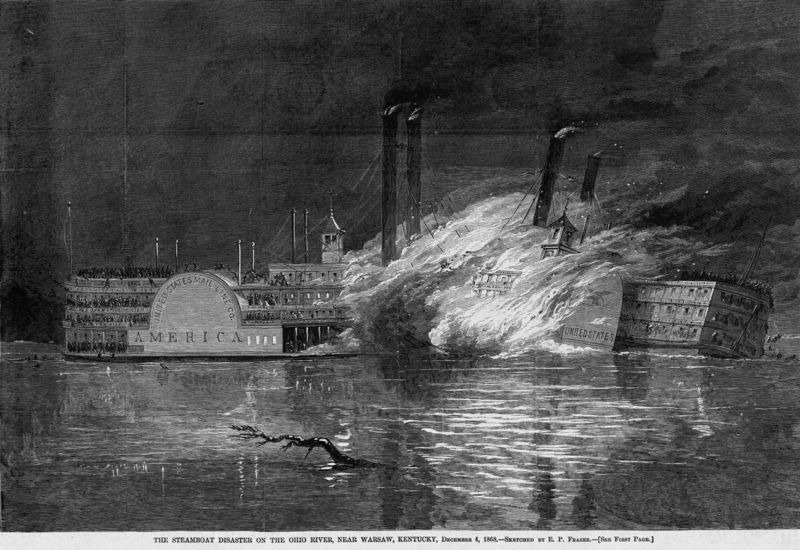
Tragic Collision
This image of the "United States" and "America" collision appeared in "Harper's Weekly" magazine. Image in the public domain.
The "United States"
This period photograph shows the burned hull of the United States after the collision and fire. Image in the public domain.
Collision Headline
This headline concerning the tragic disaster appeared in the December 6, 1868 edition of the "Louisville Courier Journal." Photograph courtesy of Tim Talbott.
J. Proctor Knott
Future Kentucky governor J. Proctor Knott, then a congressman, was on board the "America" when the collision occurred. Courtesy of the Library of Congress.
Frozen Ohio River
This photograph shows the frozen Ohio River at Warsaw, Kentucky. During the winter months captains and pilots had to be on lookout for heavy blocks of ice; yet another hazard to steamboat river travel. Courtesy of the Kentucky Historical Society.
Ole Bull
Among the passengers on the "United States" was noted Norwegian violinist Ole Bull and his stringed orchestra. Bull, shown here, survived the tragic collision. Courtesy of the Library of Congress.