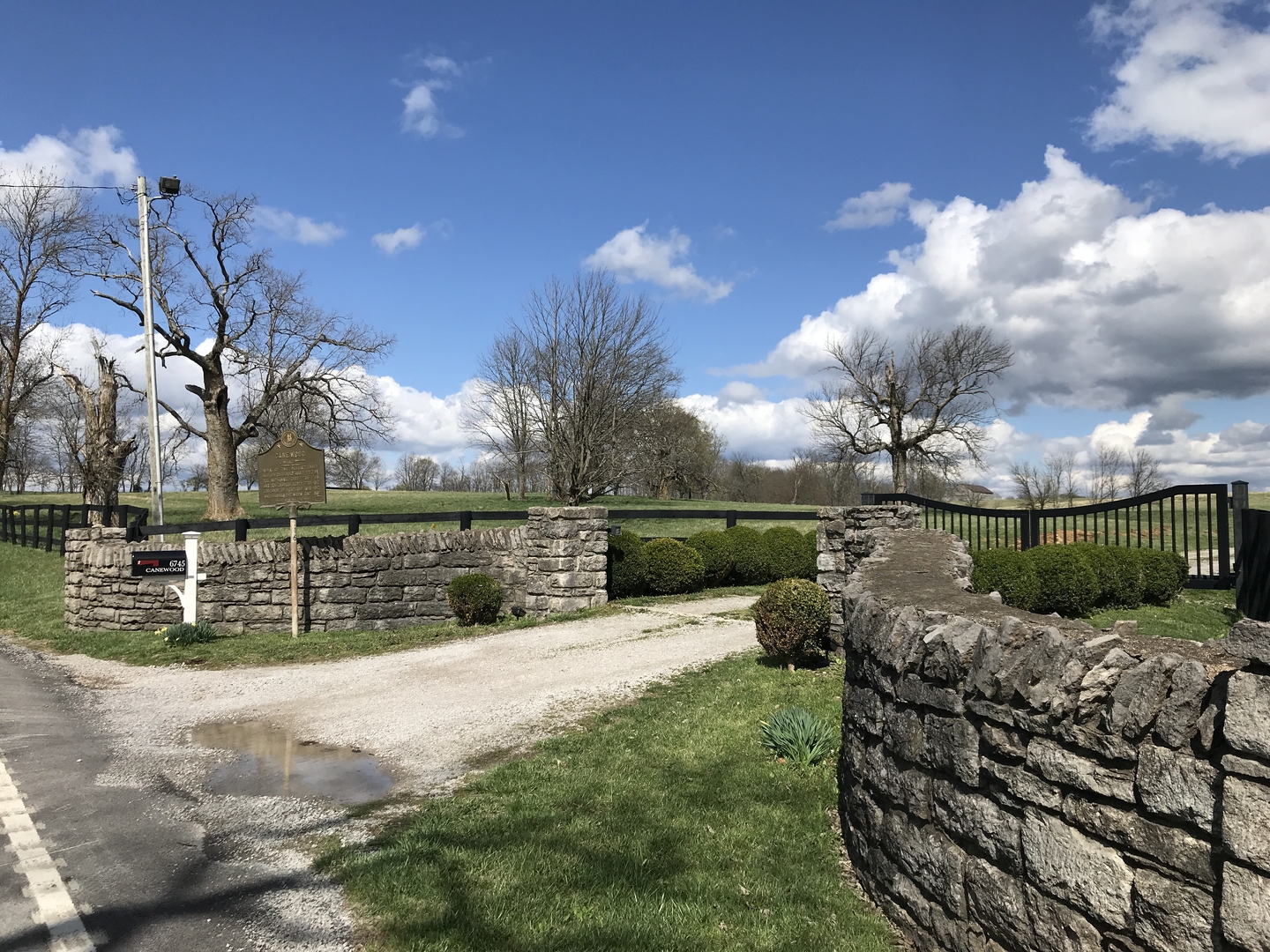
Marker #116 "Canewood"
Historical Marker #116 is located in Clark County, Kentucky on KY 627, approximately 6.5 miles north of Winchester.
Text
Historical Marker # 116 “Canewood,” marks the home in Clark County named after the natural Kentucky cane bamboo growing on the property, was built in 1793 by Colonel Nathaniel Gist, a Revolutionary War veteran.
Judge James Flanagan, an early Winchester historian, described the home as “the seat of refinement and hospitality, the ideal country home of the olden time.” He added, “The primeval house was surrounded by yards and grounds as lovely as nature … no spot upon the earth that has since looked more beautiful.”
Nathaniel Gist, son of Colonel Christopher Gist, was an officer and commander of one of Virginia’s Additional Continental Regiments during the Revolutionary War. During his youth, Nathaniel lived among the Overhill Cherokee as a trader beginning in the mid-1750s.
Nathaniel was reputedly the father of the Cherokee leader Sequoyah, who was often referred to as George Gist. Sequoyah is known best as the father of the Cherokee syllabary; he created the written language of the Cherokee, which enabled them to read and write.
There is debate over Nathaniel’s death, whether he died in 1796 or in 1812, but court records show that his wife, Judith, and John Breckinridge became administrators of his estate in June 1797. Nathaniel and Judith had four daughters, Sarah, Anne, Eliza, and Maria.
In 1807, after Judith married future Kentucky governor Charles Scott, they resided in Canewood together. Judith passed in 1833 during a cholera epidemic that swept across Kentucky. Maria and her husband, Benjamin Gratz, were the last family members to live in the house, leaving in 1853. Several years later, the home was destroyed by fire.
Like Nathaniel Gist, Charles Scott also saw active military service. He fought in the French and Indian War and, during the Revolution, was commissioned as a lieutenant colonel in the Second Virginia Regiment. In 1777, he was promoted to brigadier general and later served as chief of intelligence for General George Washington. Scott was captured at Charleston, South Carolina, in 1780, was paroled a year later, and was finally exchanged in 1782. He first visited Kentucky in 1785 and moved to the Bluegrass State two years later.
Scott is most remembered as being the governor of Kentucky, a post he held from 1808 to 1812. His retirement at Canewood was short-lived; he died on October 22, 1813.
Nathaniel Gist and Charles Scott were both buried at Canewood in a family cemetery, which no longer exists. Scott’s remains were reinterred at the Frankfort Cemetery, but current records do not indicate where Gist’s remains were relocated.
Files
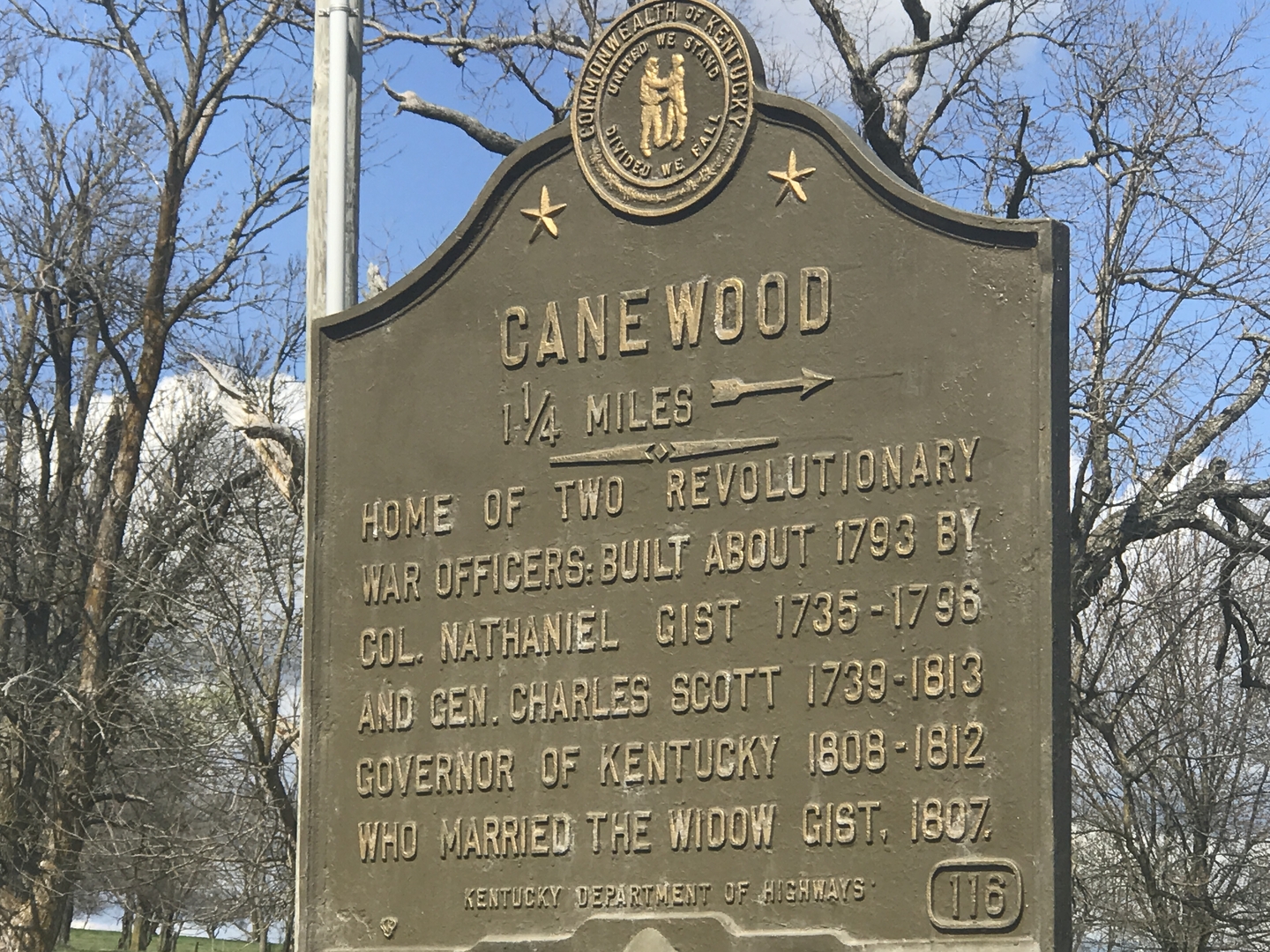
Canewood Historical Marker
Source: Used with permission from https://www.hmdb.org/m.asp?m=170085