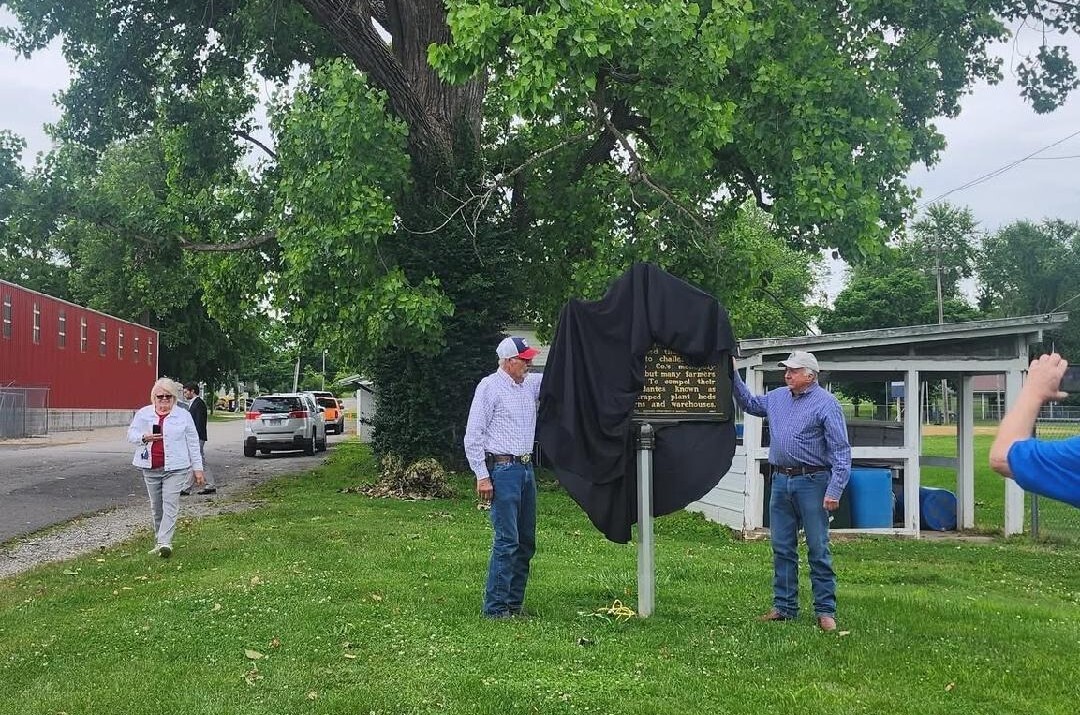
Marker #2667, "The Black Patch War in Fredonia / Rice Tobacco Factory Burned"
Historical marker #2667 in Caldwell County commemorates the Black Patch War in Fredonia and the burning of the Rice Tobacco Factory. The marker was installed on April 16, 2025, near Fredonia American Legion Post 103 at Buddy Rogers Park, the former site of the Rice Tobacco Factory. The Fredonia Valley Heritage Society held a dedication service for the marker on May 26, 2025.
Text
Tobacco was a major crop in the Fredonia Valley from the time of its settlement by European Americans. When the railroad came to Fredonia in 1887, William Rice, Jr. saw new opportunities for the Fredonia Valley. The advantages local farmers would derive from a home market for their tobacco were numerous. A new town called Kelsey (later annexed into Fredonia) had just been formed between Fredonia and the Fredonia Depot. Here, William Rice and his son purchased three and a half acres of land for a tobacco factory. The building, built in 1888, was a three-story brick and frame structure with a metal roof. It had a capacity of 450 hogsheads. It was the largest building ever located in Fredonia. The warehouse was the only large commercial employer in the area and provided jobs for both men and women.
An 1893 issue of the Princeton Banner explained that the Rice Tobacco Company owned four stemmeries, including the one in Kelsey. The firm employed about 130 stemmers. In 1893, it paid over $75,000 for tobacco and labor, handling 1,260,000 pounds of tobacco in the process. The firm’s tobacco all went directly to Liverpool, England.
By 1904, the dark tobacco farmer knew it cost at least six cents per pound to produce the tobacco. But by this time, tobacco was bringing only three to four cents a pound. The price of tobacco was beyond the control of both the farmer and the middleman and was controlled instead by the American Tobacco Trust (the Trust). This monopoly controlled almost all of the tobacco production in the United States and most of England.
Tobacco growers formed the Planter’s Protective Association in 1904 in an attempt to organize farmers into marketing cooperatives. In theory, this would empower growers to sell their crops in bulk and afford them greater leverage when confronting the American Tobacco Company. They were not as successful as they hoped and only managed to recruit approximately one third of the growers in the area, perhaps because the Trust had responded by offering higher prices to the growers who refused to join.
These frustrated and desperate farmers took matters into their own hands. They soon became known as Night Riders, and they began a vigilante campaign against the Trust and those non-cooperative farmers (known as Hillbillies) who refused to join the Association. Soon, night-riding groups sprang up in many areas of the Black Patch region. Throughout the Black Patch, the Night Riders whipped the Hillbillies and trust buyers, scraped plant beds of their young crops, and burned tobacco warehouses and barns.
By May 1906, Night Rider activity had increased. While Hillbillies now sold their tobacco at ten to twelve cents per pound to the Trust, Association members received just seven and one-eighth cents per pound. The Night Riders started scraping tobacco plant beds of non-members in Lyon and Caldwell counties. Several Hillbilly barns were burned, while scraping plant beds and whipping increased.
Night Rider activity was not as successful in northern Caldwell County. In the Fredonia Valley between Crider, Fredonia, and Farmersville, two hundred or more farmers refused to join the association or the Night Riders. According to historian James Nall in The Tobacco Night Riders of Kentucky and Tennessee, 1905-1909 (1991), “Henry Wilson, a farmer and stock dealer of Crider, was considered an unofficial leader in that section and was the only person who shot it out with the Night Riders. Although these growers had no organization, mounted groups of six, ten, or twelve men would patrol the area at night when danger threatened; and, as a result of their watchfulness, there were few Night Rider depredations in that area.”
By November 1906, the Night Riders had decided to burn independent tobacco warehouses in the area. On the night of November 12, 1906, the Rice Tobacco Factory was burned to the ground. The first floor was saturated with coal oil before the Riders’ torches lit the fire from the inside. “It was a large factory, and, although it made a big fire, it burned so rapidly that many citizens two and three blocks away slept through it all,” states Nall.
The November 13, 1906, issue of the New York Times explained, “The Kelsey Warehouse (Fredonia) was wrecked by dynamite set by the Night Riders. The explosion shattered windows in many houses. Bloodhounds have followed the trail of the wreckers for ten miles into Caldwell County. The stemmery had machinery for steam casing and a drying outfit for tobacco.” The same article mentions that “a letter had been sent to the growers who sold tobacco to the Trust warning them not to sell their tobacco and was signed by the Night Riders. After the warehouse fire, Rice promised not to sell the tobacco in his warehouses to the Trust.”
This was not the last trip by the Night Riders to Fredonia. In February 1908, the Night Riders took possession of the town while on their way to View in Crittenden County. This brief but shocking instance of mob rule left a deeper impression upon Fredonia’s citizens than the burning of the Rice Tobacco Factory. The Night Riders captured Oscar Scarberry, the Cumberland Telephone and Telegraph night operator, and cut the wires at one o’clock in the morning. Then 75 men rode on to View, five miles away, where A. H. Cardin, the former populist state leader and only buyer of independent tobacco in the area, lived. Upon arriving, they attacked and burned the farm.
A party of 25 men stood guard in the streets of Fredonia to prevent anyone from giving an alarm to Cardin or alerting the authorities. One rider, after cutting the Cumberland telephone cable, climbed a telephone pole to cut another wire when the pole broke. He was severely injured and taken away by Night Riders. The mob also tore out the telephone in C. B. Lloyd’s store. The clerk at Bugg’s Drug Store built a fire in the stove to keep the raiders warm while they waited for the others to return from View.
Fredonia was held captive for three hours. These facts represent one of the most noteworthy historical events ever experienced by this small town.
The marker text reads:
THE BLACK PATCH WAR IN FREDONIA
Farmers in western Ky. and Tenn. fought with buyers over the price of their tobacco from 1904-1909. The farmers created the Planters’ Protective Assn. to challenge the American Tobacco Co.’s monopoly on the cash crop, but many farmers refused to join. To compel their cooperation, vigilantes known as Night Riders scraped plant beds and burned barns and warehouses.
RICE TOBACCO FACTORY BURNED
While Night Riders were not as successful in northern Caldwell County, they did visit Fredonia twice during the Black Patch War. On Nov. 12, 1906, they burned the Rice Tobacco Factory at this site. In Feb. 1908, they cut phone lines and held Fredonia captive for 3 hours while others rode to nearby View, Ky., to burn the property of tobacco buyer A. H. Cardin.