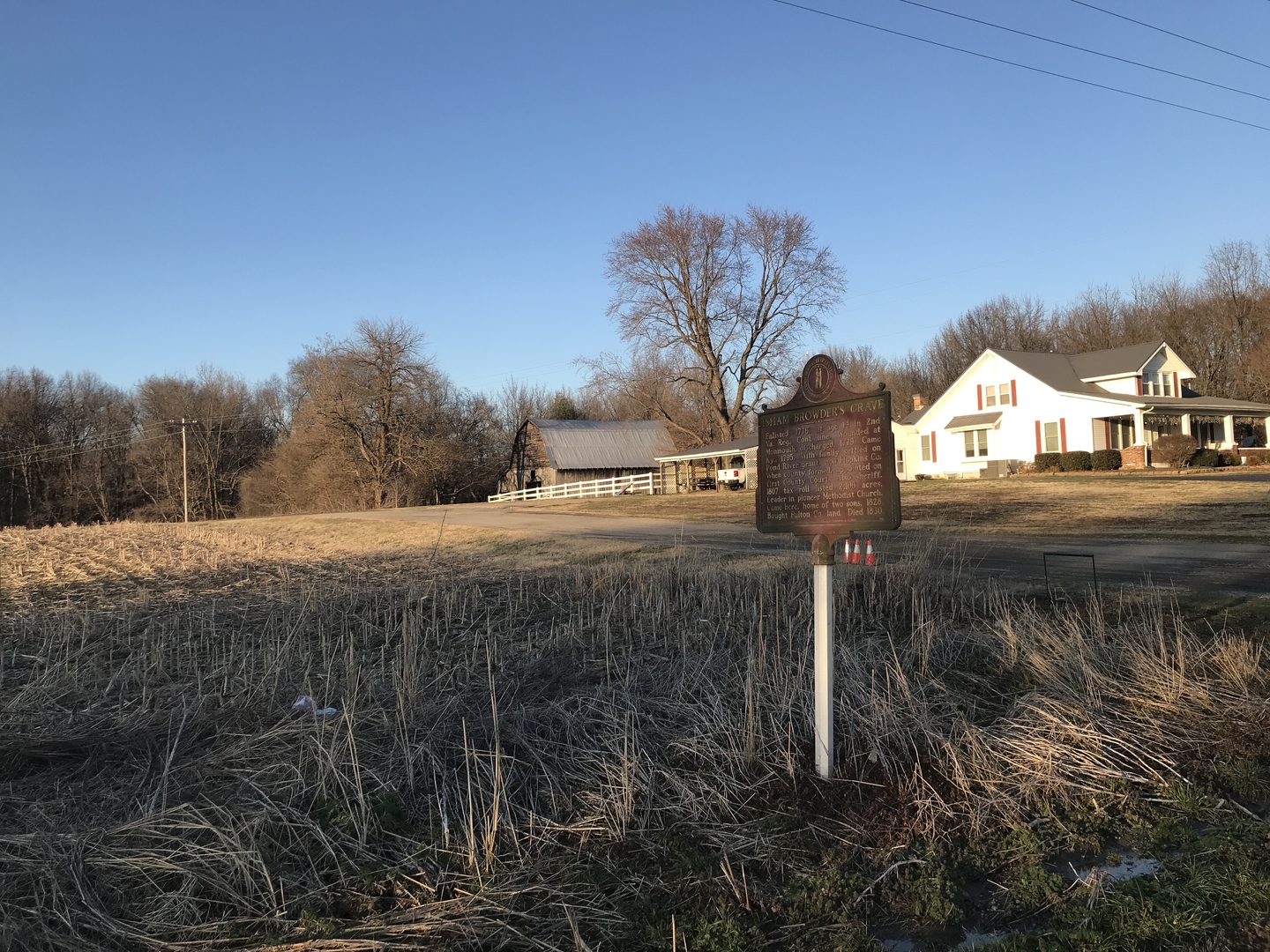
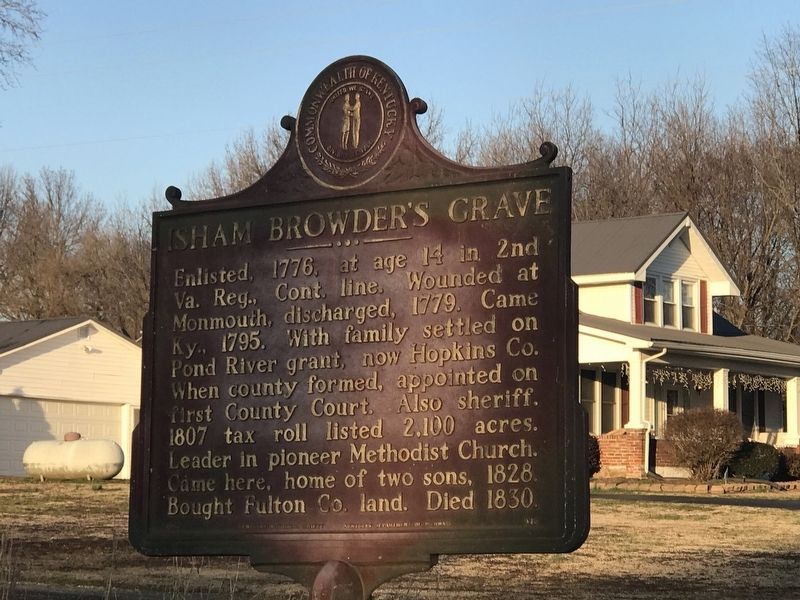
Marker #973 Isham Browder's Grave
Marker #973 sits on the north side of East State Line Road, the road that divided Kentucky and Tennessee, about 2.8 miles east of Fulton, Kentucky. The marker sits on the west corner of a farm-access driveway. Visitors should be cautious of private-use land when viewing the marker.
Text
Historical Marker #973, “Isham Browder’s Grave,” is dedicated to Private Isham Browder who served in the First Company of the Second Virginia Regiment during the American Revolution.
The earliest war records for Browder are in the regimental orderly books of Virginia. He likely enlisted near Charleston, South Carolina, before fighting under Captain Alexander Parker at the Battle of Monmouth in 1778. General Charles Lee led the American troops at Monmouth, but Lee was failing until General George Washington arrived to lead the remaining soldiers to victory. In that action Browder was slightly wounded in the arm. He continued to serve for fourteen months after the battle and was discharged from the military on August 30, 1779, after serving three years.
Browder moved to Kentucky between 1793 and 1795.
According to records, between 1798 and 1810, Browder secured ten land grants from Virginia totaling 2,153 acres around the Pond River in present-day Hopkins County. He established a major tobacco business and flour mill. Tax listings in 1807 show him owning eight horses and six enslaved African Americans. By 1817, tax records showed his taxable properties as $5,491, a good sum in the early nineteenth century.
In addition to the land in Kentucky, he was granted one hundred acres in Ohio between the Little Miami and the Scioto Rivers, which he sold to Nathaniel Randolph. Randolph bought approximately two hundred more acres in Ohio, which Browder bought in 1805.
Shortly after Hopkins County was formed, Governor Christopher Greenup appointed Browder as justice of the peace. Records also show he was the surveyor of proposed roads and inspector of tobacco.
In 1806, a man described as “tough and wily” named Duncan McArthur purchased about one thousand acres of land in that area, which mistakenly included Browder’s three hundred acres. Browder was not willing to part with the land for the offered price, and they both decided the courts needed to be involved. However, by the time they went to court, Randolph, the previous owner, had died. McArthur claimed there were no fixed landmarks for the property and argued that Browder had improperly surveyed the land. The Ohio courts sided with Browder; however, McArthur appealed to the United States Supreme Court where Chief Justice John Marshall ruled in his favor. The court battles that ensued left Browder bankrupt. To pay for the court cases and lawyers, Browder had to mortgage his properties and auction off his business. McArthur later became governor of Ohio.
Browder later moved his family to cheaper land in Hickman County, which later became Fulton County. He died on February 19, 1830, and was buried on his farm in Fulton County.
Files
Marker #973 Isham Browder's Grave
Source: Used with permission from https://www.hmdb.org/m.asp?m=192708.